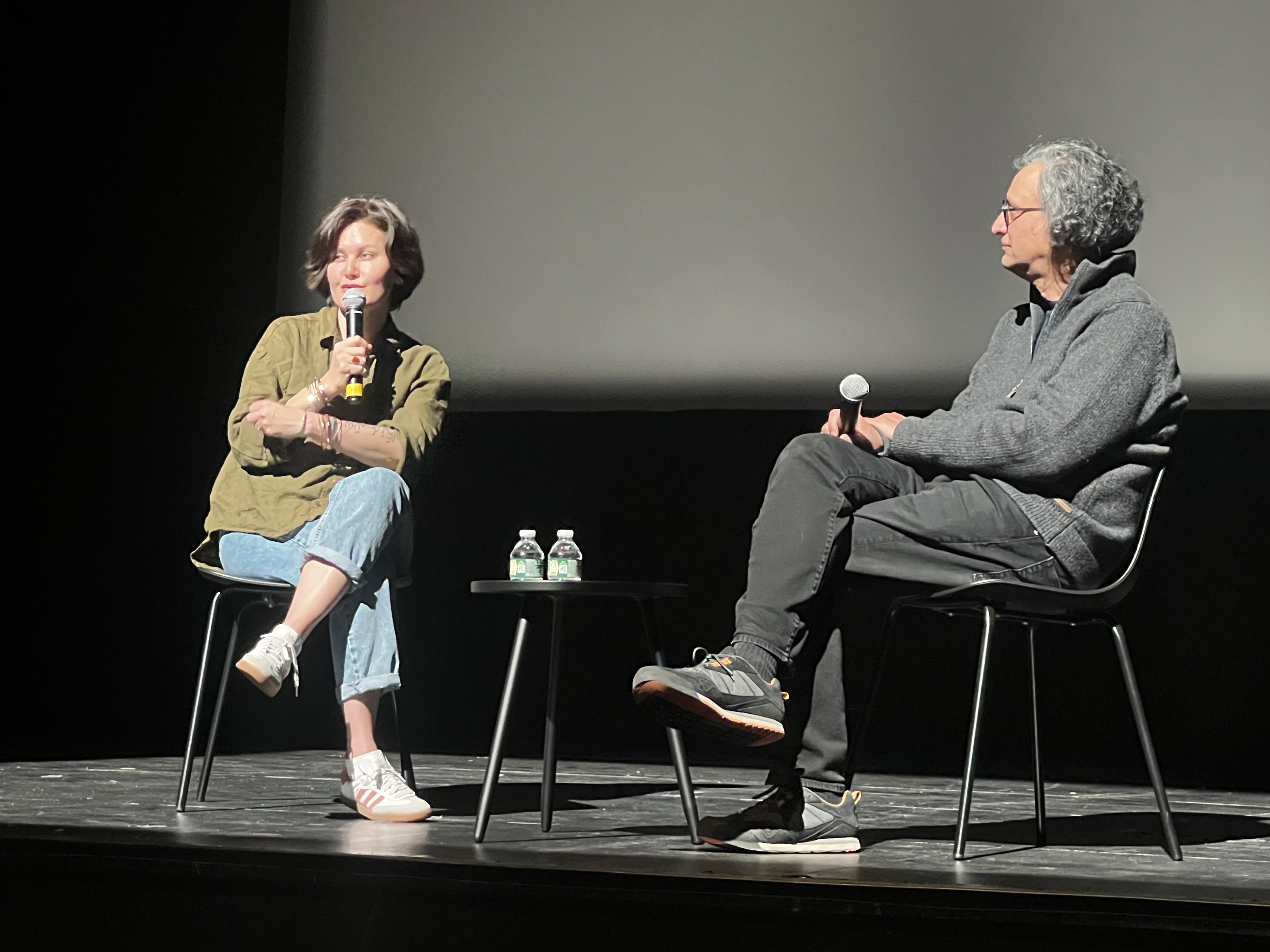
Filmmaker Sahraa Karimi, the first female chair of the Afghan Film Organization who fled when the Taliban seized power in 2021, spent three days in Ithaca as a guest of Ithaca City of Asylum. Highlights included two well-attended public screenings, a guest lecture, and meetings with students, staff, and faculty at Cornell University, Tompkins Cortland Community College (TC3), and Ithaca College.
ICOA teamed up with Cornell’s South Asia Program, part of the Mario Einaudi Center for International Studies, in bringing Karimi to Ithaca and hosting her during her stay.
Karimi spent Wednesday, March 6 at Cornell, where she met with Afghan students and scholars and gave a guest lecture in the course “The Cultural and Political History of Modern Afghanistan” taught by visiting scholar Sharif Hozoori, who is at Cornell under the university’s Scholar Under Threat program. After dinner with students at Carl Becker House, she screened her award-winning 2009 documentary Afghan Women Behind the Wheel for more than 70 people at Cornell Cinema. The screening was followed by a spirited Q&A led by art history professor Iftikhar Dadi.
On March 7, Karimi traveled to TC3, where she showed a short film to 45 students, faculty, and staff. She spent the latter part of the afternoon at Ithaca College, where she toured the film department and screened a film for students in the course “Modern South Asia” taught by associate professor (and ICOA chair) Jason Freitag.
Her visit was capped by a Thursday evening screening of her 2019 drama Hava, Maryam, Ayesha to 100 moviegoers at Cinemapolis. The film is an intimate look into the lives of three women from different social backgrounds facing personal crises in pre-takeover Kabul. After the film, she spoke with Zillah Eisenstein, emerita professor of politics and gender studies at Ithaca College, before taking questions from the audience. She decried the US role in the fall of Afghanistan, described what it was like to be “at the top of the Taliban’s kill list,” and spoke of the challenges of working on Afghan themes while in forced exile overseas.
Karimi’s visit was made possible in part by funds from the Statewide Community Regrants program from the New York State Council on the Arts, with the support of the Office of the Governor and NYS Legislature, and from Tompkins County, administered by the Community Arts Partnership of Tompkins County. Additional financial support was provided by a Title VI grant from the U.S. Department of Education. Accommodations were provided by Cornell’s Carl Becker House.
Thanks to Daniel Bass and Gloria Lemus-Chavez of the South Asia Program, Kathi Colen Peck of the Einaudi Center, and Amanda Carreiro and Lori Leonard of Becker House for help with logistics, transport, food, and lodging.

 Ithaca City of Asylum