Ithaca City of Asylum
Providing refuge for persecuted writers and artists since 2001
Visual Art on Banned Books
ICOA is pleased to invite you to an art show at the Tompkins County Public Library, featuring art based on Banned Books. The exhibition is available until December 20, 2013 and contains work by two Ithaca City of Asylum board members–Bridget Meeds and Kenny Berkowitz. 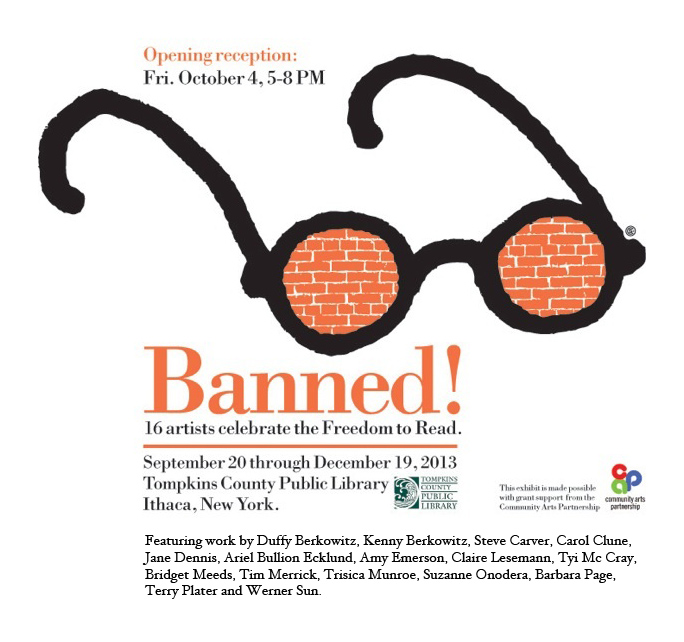
Using Fiction for Social Change
Exiled Venezuelan Author Reads from Dystopian Novel for Voices of Freedom 2013
Venezuelan political critic and renowned author Israel Centeno read from his novel La Torre Invertida, (translated as The Tower Overturned) as the highlight of Ithaca City of Asylum’s Voices of Freedom 2013. The novel is about the unraveling of a city where dystopia becomes its citizens’ harsh reality. Centeno’s talk began at 2:00 P.M. on Sunday, September 29, in the Tompkins County Public Library’s BorgWarner Community Room.
“In Venezuela,” Centeno says, “the independent journalist is constantly threatened with prison, demands, and the so-called ‘ire of the people’.” In such a world, fiction is an alternative for the expression of social criticism and a call for change.
A theme in The Tower Overturned is how rats and “man-rats,” are signs of corruption in society. “The rats are mutants,” Centeno continues. “We have a crowd. Half are some kind of gothic homeless and half are rat-men. They play a game between the towers, symbols of modernity. The game is a sort of Maya ball game that ends in sacrifice. The fight begins to turn against the corrupt bureaucrats and the powerful leaders themselves.”

Israel Centeno
Centeno is the author of poetry, short stories, and novels and is regarded as one of the most important Venezuelan literary figures of the past fifty years. He has won numerous awards, including the Federico Garcia Lorca Award in Spain and the National Council of Culture Award in Venezuela in 1991. Born in 1958 in Caracas, Venezuela, he is currently living in the United States as an exile from his native country. Centeno has been the writer-in-residence at the City of Asylum/Pittsburgh since 2011. Displaced under the presidency of Hugo Chavez, he has just published his tenth book, Bamboo City (Wild Age Press, 2012), his first in English. Unlike magical realism of Latin American novels of the 20th century, Centeno describes his work as “distorted realism about a distorted realm,” drawing from popular forms such as vampire novels, Gothic fiction, and absurdism.
As part of the program, Ithaca City of Asylum’s resident writer, Sonali Samarasinghe, exiled from Sri Lanka and presently an international visiting scholar at Ithaca College, read a brief excerpt from her memoir-in-progress. Pablo Cohen, head of the classical guitar program and a faculty member in the Latin American Studies program at Ithaca College, performed regional music.
“Voices of Freedom” is an annual event of Ithaca City of Asylum (ICOA) and is presented this year in partnership with the Tompkins County Public Library as part of Banned Books/Freedom to Read Week. This event is made possible with grant support from the Community Arts Partnership. Additional funding is provided by Poets & Writers, Inc. with public funds from the New York State Council on the Arts with the support of Governor Andrew Cuomo and the New York State Legislature. Co-sponsors include Amnesty International group 73 Ithaca, and Cornell University’s Carl L. Becker House, Department of Romance Studies, Latin American Studies Program, Rose Goldsen Lecture Series Fund, and the Society for the Humanities.
ICOA is a project of the Center for Transformative Action, a non-profit organization affiliated with Cornell University, and works in partnership with Cornell, Ithaca College, and Wells College.
Samarasinghe Gives Commencement Address
Sonali Samarasinghe, Ithaca City of Asylum’s resident writer, was selected to give the commencement address at The Ellis School in Pittsburgh on June 6, 2013. The Ellis School is Pittsburgh’s only independent school dedicated to the education of girls and young women from age three through grade twelve.
During Samarasinghe’s talk to the graduates and their friends and families, she congratulated the graduating students while also encouraging them to support the universal human right of education for girls all over the world.
“As you go forth into your future, holding hope in one hand, and infinite possibility in the other, I urge you, to give pause, and be thoughtful, of the struggles of women and girls everywhere.”
She told them the story of Malala, a Pakistani teenager who was shot for advocating for the education of girls, and also shared her own story of bravery in the face of oppression in Sri Lanka. In conclusion, she urged the graduates to go forth into the world to serve others with courage and empathy. “It is my hope, that whatever life may fling at you along the way, you will be defined, not by how hard you fell down, but by how courageously you picked yourself up, and by how readily you extended a hand to others, to raise them to their feet, once again.”
Samarasinghe is an award-winning journalist and human rights activist. She practiced law in Sri Lanka for twenty years and worked as a journalist focusing on human rights, including government corruption and women’s issues. Currently, in addition to being ICOA’s writer-in-residence, she is also a visiting scholar in residence within the Honors Program at Ithaca College’s School of Humanities and Sciences. Samarasinghe is working on a book about her experiences in Sri Lankan politics and media.
Calls Beyond Our Hearing and Murder, She Rode

Holly Menino, ICOA board member, produced two books recently, with very different audiences. The first, Calls Beyond Our Hearing: Unlocking the Secrets of Animal Voices was published last April and is a fascinating exploration of animals, their voices, and their survival. Recovering from hearing loss after suffering a concussion, Menino was drawn to discovering why sound is so important to life. Her research led her to travel the world to locate the latest research on the vocal communications of a wide range of animals as they feed, play, fight, mate, and communicate for survival. In this fascinating book she explains how, voice by voice, researchers can assemble the building blocks of animal communication, such as: how túngara frogs distinguish one mate from thousands of suitors; the purposeful song duets of rare birds in a remote island wilderness; England’s iconic red deer and the interloper that is diluting the species; how meerkats gather, warn or help each other, and reject outsiders with vocalizations; and the communication of elephants in close groups and across great distances.
Kirkus Reviews said the book was “a charming meditation on the world of sound” while the Washington Post stated that “with her literate and lively style, [Menino] makes her book a scientific page-turner… Inviting, rigorous and balanced.” Natural History magazine published an excerpt from Calls Beyond our Hearing, about England’s iconic red deer, in its February 2012 issue. Audubon ran an different excerpt on its website, along with a sound file for a bird that sings duets (you can read about and listen to the bird here) and listed it as one of the magazine’s most notable science books of 2012 (their review is also available here). Calls Beyond our Hearing was also listed with the One Spirit Book Club, which offers inspirational books by popular authors. Calls Beyond Our Hearing, published by St. Martin’s Press in April 2012, will engage anyone interested in the musical world of creatures, and what animal communication can teach us about our own voices and songs.
 On the other side of her writing life, Menino’s murder mystery Murder, She Rode is in production at Minotaur Books with publication scheduled for the summer of 2013. The story is set in the horse world, more specifically the world of three-day eventing. Murder, She Rode is Menino’s first work of fiction for adults. She is also the author of Pandora: A Raccoon’s Journey, a novel for children, and the nonfiction books Forward Motion: Horses, Humans, and the Competitive Enterprise and Darwin’s Fox and My Coyote. A contributor to Smithsonian and National Geographic, she has served as editorial director and contributor to numerous public radio features about the natural world. She is a member of the Ithaca City of Asylum board and says ICOA was a great discovery for her. “It is inspiring to work with this group of friends who are such strong advocates for freedom of expression and who are willing to put their beliefs into action.”
New Play ‘K2’ Stars ICOA Writer-in-Residence
Apart from her teaching and speaking engagements, ICOA Writer-in-Residence Sonali Samarasinghe also began her Ithaca acting debut in April.
 Samarasinghe was part of the three-member cast of “K2,” Patrick Meyers’s play based on the real-life experience of two American climbers on their expedition on the world’s second-highest mountain. This local production, presented by the Readers’ Theatre of Ithaca and directed by Anne Marie Cummings, featured performances by Tim Mollen and Eric Sterbenk as the two mountain climbers and a reading of stage directions by Samarasinghe.
“I like this play’s rawness, its unfiltered visceral emotions that we all have to deal with sometimes in our lives,” shares Samarasinghe in the trailer for “K2.”
In an interview on WSKG, Mollen says Samarasinghe added her “rich, gorgeous speaking voice” to “K2,” giving the play “a richness and flavor that would not have been there.”
“K2” was on stage at Lehman Alternative’s Black Box Theatre (111 Chestnut Street) on Friday and Saturday, April 26 and 27. A talk-back session followed each performance: Todd Miner, executive director of Cornell Outdoor Education, on the 26th; Gail Holst-Warhaft, Tompkins County Poet Laureate, on the 27th; and Peter Rothbart and Matthew Ocone, who provided the music throughout the play’s run, on the 28th.
ICOA at Spring Writes 2013
ICOA writer-in-residence, Sonali Samarasinghe and novelist Edward Hower, a longtime ICOA board member, were featured speakers at “Writing to Create Change,” a reading and panel discussion that is part of Ithaca’s Spring Writes Festival. The event took place on Saturday, May 4, at the Tompkins County Public Library at 3:00 to 4:30 p.m.
Samarasinghe is active in an international community of journalists engaged in issues of democracy and human rights. In addition to writing fiction and editing for the new Ithaca publisher Cayuga Lake Books, Hower teaches in Cornell’s Prison Education program. The ICOA participants will be joined by radio host Jim Murphy and writer Jennifer Pacanowski, who are active in the Veteran’s Sanctuary. Common Councilman Seph Murtagh will moderate the discussion.
Spring Writes is presented by the Community Arts Partnership and is now in its fourth year.

Samarasinghe’s Class Hosts UNESCO Human Rights Chair
Ithaca City of Asylum’s writer-in-residence, Sonali Samarasinghe, has maintained a lively teaching schedule in her capacity as Visiting Scholar in Residence in Ithaca College’s Honors Program. Her course Human Rights Litigation has brought a number of guest speakers to the Ithaca College (IC) campus, and March 22, the featured speaker will be Dr. Amii Omara-Otunnu, UNESCO Chair in Comparative Human Rights.
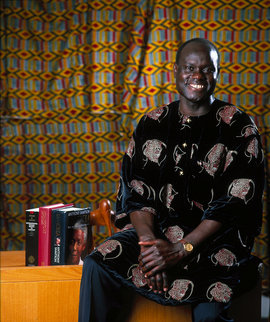
Dr. Omara-Otunnu
A professor of history at University of Connecticut, Dr. Omara-Otunnu has managed a dual career in academia and the movements for human rights, democracy, and social justice. He has published broadly on the interplay of politics, the military, and human rights in Sub-Saharan Africa, and at the same time has been actively engaged in numerous international boards and commissions.
Dr. Amara-Otunnu will present “The Challenge of Leadership and Human Rights in the 21st Century,” on Monday, March 22, from 7:00 to 9:00 p.m. in the VIP Lounge, at IC’s Athletics and Event Center. A reception will follow Dr. Omara-Otunnu’s talk. This event is free and open to the public.
Festival Film Features ICOA Writer-in-Residence
Silenced Voices: Tales of Sri Lankan Journalists in Exile, was a presentation of Ithaca College’s Finger Lakes Environmental Film Festival (FLEFF) this year. The documentary features Sonali Samarasinghe and her experiences with the Sri Lankan government’s repression of the media. Samarasinghe is ICOA’s writer-in-residence and is Visiting Scholar in Residence for the Ithaca College Honors Program in the School of Humanities and Sciences.

Silenced Voices: Tales of Sri Lankan Journalists in Exile
The documentary by Beate Arnestad is about freedom of speech and messengers of truth and how much individuals are willing to risk to bring information to light. Samarasinghe is highlighted in the film as one of four exiled journalists from Sri Lanka who have been “silenced” and targeted for assassination because they exposed corruption, massacres of civilians, and other war crimes committed by the state.
“We shall have to repent in this generation,” says Arnestad, “not so much for the evil deeds of the wicked, but for the appalling silence of the good people.”
As part of FLEFF, Silenced Voices was shown on April 5 at Cinemapolis, 120 East Green Street, Ithaca, N.Y. The evening featured post-screening commentary by Samarasinghe with a discussion moderated by Ithaca College writing professor Barbara Adams.
Samarasinghe Featured at Pittsburgh Event
Sonali Samarsinghe, ICOA’s resident writer, was the featured speaker at an event hosted by City of Asylum/Pittsburgh, Wednesday, March 6. Samarasinghe gave a reading from her work and, after this presentation, she conducted a two-day residency at the Ellis School, gave further readings, and was a guest on local radio.
Samarsinghe read from her work-in-progress, an autobiographical account of politics and the tension between politicians and the media in Sri Lanka. This is the project that has engaged her since she assumed her ICOA residency in August 2012. In addition to her writing, Samarasinghe serves as Visiting Scholar in Residence in the Honors Program at Ithaca College and is a visiting scholar in Cornell University’s South Asia Program.
Ithaca City of Asylum and City of Asylum/Pittsburgh maintain an ongoing visit exchange of their resident writers. In 2011, Burmese activist, poet, and novelist Khet Mar visited Ithaca as the featured speaker for ICOA’s Voices of Freedom, cosponsored by the Tompkins County Library, and in 2007 Horacio Castellanos Moya, an exile from El Salvador whose work in translation has attracted the attention of the U.S. media, spoke to the Ithaca community and visited Ithaca College.
Telling Truths in Arusha
Ithaca College screened Telling Truths in Arusha, a powerful documentary by Norwegian filmmaker Beate Arnestad, on February 11, 2013, at 7 p.m. in Textor 103. A discussion with filmmaker Beate Arnestad and prosecutor Brian Wallace, moderated by politics professor Dr. Peyi Soyinka-Airewele, followed the screening. This screening and discussion took place in conjunction with a class on International Human Rights Litigation being taught at the college this spring by Scholar in Residence Sonali Samarasinghe.

Telling Truths in Arusha
Telling Truths in Arusha follows the case of Father Hormisdas, who was put on trial by a United Nations tribunal 15 years after his alleged involvement in the 1994 Rwandan massacre. Prosecutor Brian Wallace vigorously pursues the case, but with little hard evidence, the Norwegian judge, Erik Møse, has to base his judgment solely on witness testimony — and their versions of “the truth.”
The documentary explores the complexities of seeking justice after genocide. Arnestad handles the subject with sensitivity as she follows the legal processes that seek to bring about justice after genocide. Unique courtroom access makes this a documentary of rare insight.
Samarasinghe was one of the subjects of Arnestad’s most recent films, Silenced Voices. A lawyer and journalist who focused on government corruption in her native Sri Lanka, Samarasinghe fled the country with other members of her family in 2009 following the assassination of her husband. Silenced Voices, which will be screened at this spring’s Finger Lakes Environmental Film Festival, tells the story of the civil war in Sri Lanka from the point of view of journalists who have faced threats for exposing war crimes, corruption and massacres of civilians.
The Ithaca College Honors Program sponsored the February 11 screening and discussion, with co-sponsorship from the school’s departments of politics and writing.
Join our mailing list

 Ithaca City of Asylum