The following is the text of Raza Ahmad Rumi’s introductory remarks at the IMAGINE! event on October 2, 2026, at the Kitchen Theatre Company. He was paired in conversation with the writer and filmmaker Austin Bunn.
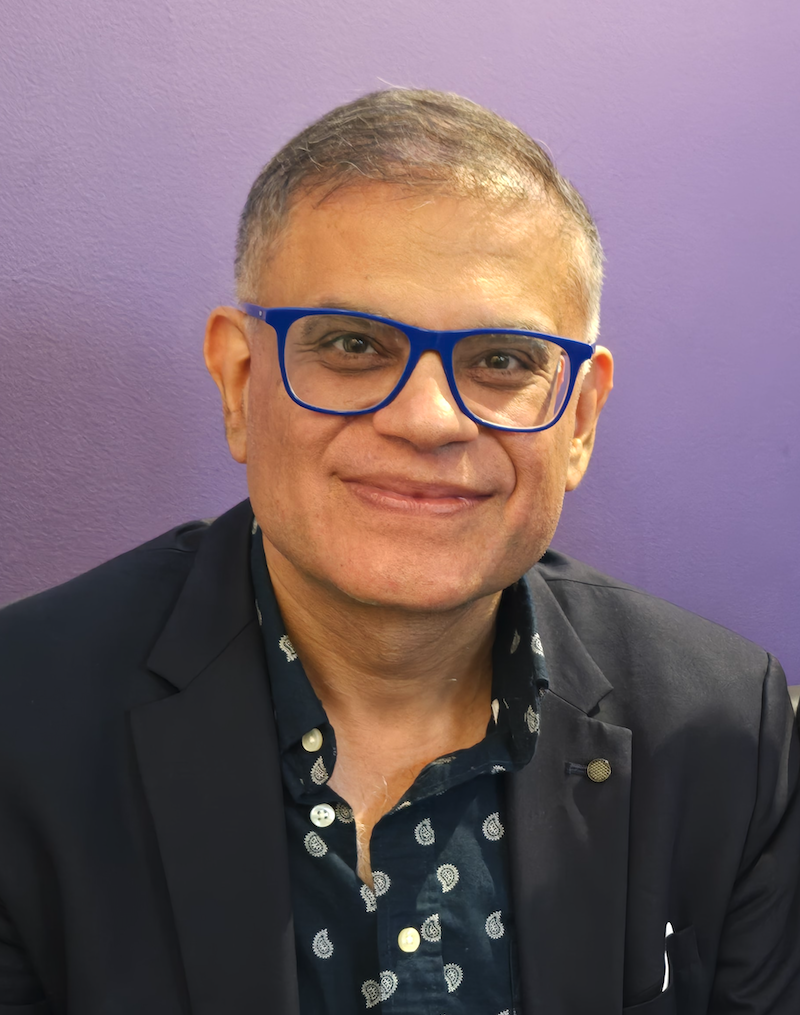
Thank you to Ithaca City of Asylum, and to all of you for being here. I’ve spoken on many panels, but this one is different. This is not a panel for me. It is a homecoming.
I came to Ithaca in 2015 with a suitcase, a laptop, and a great deal of uncertainty. I didn’t know whether I would write again. Ithaca City of Asylum gave me a house, time, and safety. But the real gift was people: novelists, poets, essayists, translators. For a journalist who lived by deadlines, sitting with poets was a re-education. And the generosity came without conditions. No one asked me to perform gratitude. They simply let me be a writer again.
I changed here. Journalism lives in the present tense. In Ithaca, I began writing in the past tense, about memory, my parents, the streets of Lahore. Lahore was no longer home, and Ithaca was not yet home. I lived in between, and I came to see that in-between as a place of its own. Home stopped being an address. It became a question I keep rewriting. Later, serving on the board of ICOA, I saw from the other side how much quiet work it takes for a small town to keep a door open for a stranger.
That door is what I want to talk about. What this organization protects is not only writers. It protects imagination, and imagination is a public good.
A public good is something that isn’t used up when one person enjoys it. Clean air. A lighthouse. A library. A poem does not run out when a stranger reads it. A story about Lahore read in Ithaca belongs to whoever needs it.
But public goods have a weakness: they are always neglected. No one can own them or sell them, so the market passes them by. Someone has to choose to sustain them. Lighthouses don’t build themselves, and neither do the conditions imagination needs: time, safety, translation, readers, the freedom to be wrong. This organization has done exactly that. It has paid, collectively, for something no one profits from.
Why does it matter? Because we cannot be good to people we cannot picture. Before compassion, before justice, before law, there is the simple act of imagining another life from the inside. Democracy depends on that act. A citizen who cannot imagine a stranger will vote for walls.
To think well, we have to let our imagination travel, to leave our own position for a while and stand, in our minds, where others stand. That is what this place has done for more than two decades. It lets a town’s imagination travel, and it lets writers like me travel back.
Imagination is also political. Nations themselves are imagined. We will never meet most of our fellow citizens, yet we imagine ourselves bound to them. So the borders we live inside, and the enemies we are taught to fear, are also acts of imagination. That means they can be imagined differently.
The ability to imagine a better future is not evenly shared. The powerful learn it from childhood. The poor and the displaced have to fight for it. When a young person pictures a life beyond the one they were born into, that is not fantasy. It is one of the most serious things a human being can do.
That is why censorship is so dangerous. It doesn’t only silence words; it shrinks what people believe is possible. It fences off the commons. When a writer is silenced in Lahore, Tehran, or Kabul, all of us lose a little air. When a writer is sheltered, the commons grows.
My own writing has always been an argument with borders. In 1947, a line was drawn, and overnight the people on the other side became the enemy. I grew up with textbooks and wars that said so. But Lahore and Delhi share a thousand years: Sufi saints, Mughal stones, the poetry we still recite, the language we curse and pray in, the food we still argue about.
My book Delhi by Heart was my attempt to imagine against official memory, to walk Delhi not as a Pakistani in enemy territory but as someone returning to a shared house. I went to Delhi looking for an enemy, and I found a mirror.
That has been the quiet thread through all my work, in journalism, books, and teaching: we cannot change the world until we can imagine a better one, and say it out loud.
The same thread runs through the memoir I’ve been writing, and rewriting, for years: arriving in Ithaca, leaving it, and becoming an American citizen. Citizenship is a document and an oath. But it is also an act of imagination, writing yourself into a new “we.” Exile gives you double vision, two homes held in the mind at once. I’ve come to see that as a kind of second sight.
For years I wrote from the wound. Now I am trying to write toward a future, not only a past. The trauma is part of the story. I don’t want it to be the ending.
My newest project began with journeys to Italy. History was everywhere underfoot, a civilization that still shapes the whole Euro-Atlantic world. Rome’s own founding myth is a refugee story: a man fleeing a burning city with his father on his back, crossing the sea to build a new home. Europe’s grandest origin story begins with a boat.
But what moved me most was not the ruins. It was the people among them: newcomers from everywhere, and especially young men, and a few women, from Pakistan. Some came by sea. The Mediterranean has become a graveyard. In 2023, Pakistanis were among the dead off Italy’s coast and off Greece, where hundreds drowned in a single night.
What struck me is that they carry imagination with them: a remittance home, a sister’s school fees, a mother’s medicine, a future they have seen only in their minds. This is the hard-won ability to aspire, at its most desperate. We call it illegal entry. I would call it an act of imagination, one we have made deadly.
So I ask: what world should we imagine? One that does not denigrate the immigrant or reduce people to numbers. One that respects labor, the hands that pick, cook, build, clean, and care, so often unseen. One where citizenship is wider than a passport, rooted in shared humanity and in an old idea we are in danger of forgetting: humanism.
Ithaca City of Asylum taught me that a small town can imagine a large welcome. That is what a public good looks like. Imagination, shared, becomes a place where people like me can live, and write, and begin again.


